
ABOUT LIUDMILA
When the Life I Built
Fell Away
After 18 years in international advertising, strategy and leadership, I left corporate life and discovered how much of who I believed myself to be had been built around role, achievement, recognition and belonging.
When those structures fell away, I entered a prolonged identity and spiritual crisis that changed the direction of my life. I had been through dark places before and had always been seeking something I did not yet know how to name, but nothing had ever felt like this.
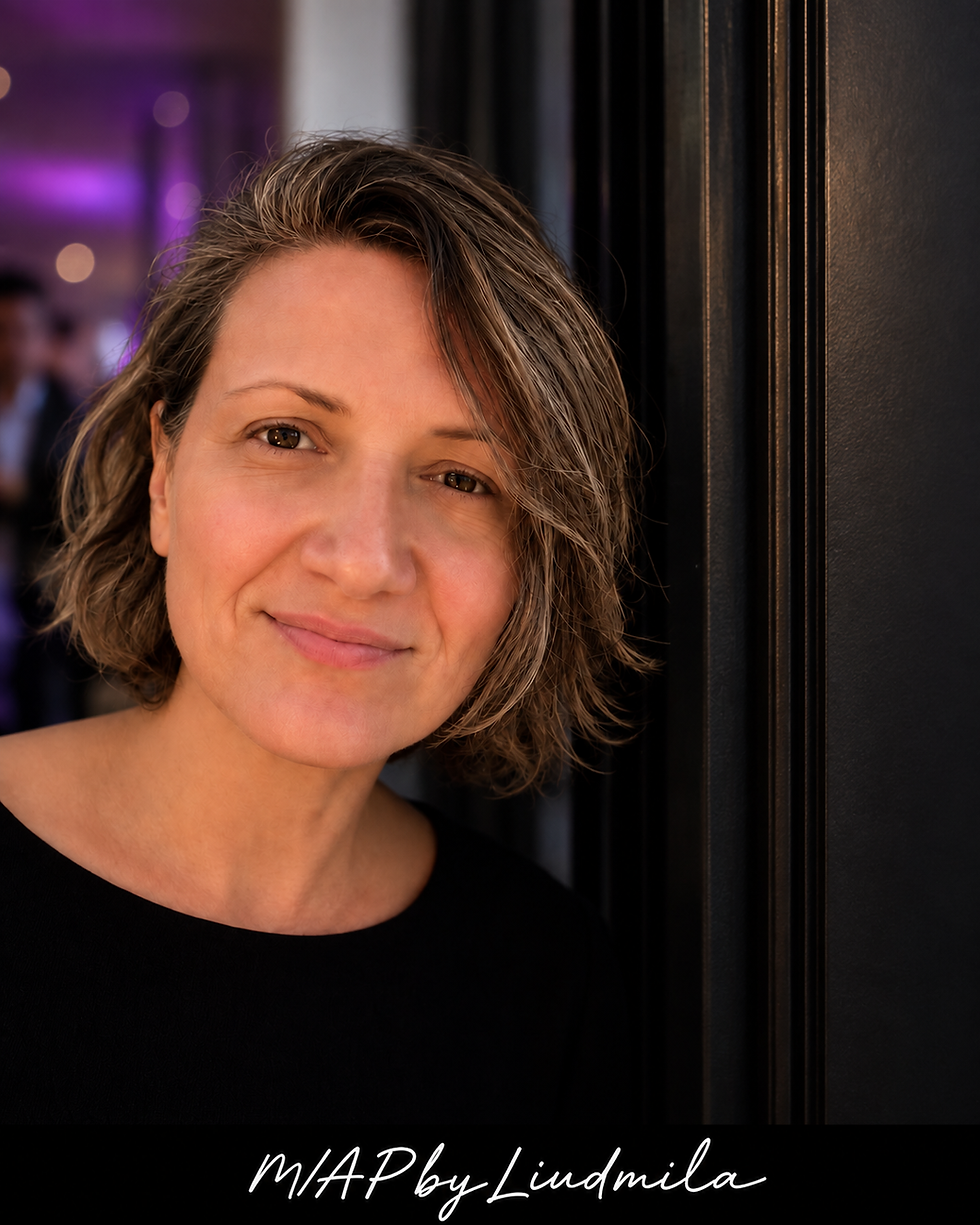
LEARNING TO SEE WHAT WAS BENEATH IT
For around seven years, I lived through what I can only describe as a dark night of the soul: intense panic attacks, extreme anger, depression and an anxiety disorder, lived largely in private while I continued to function outwardly.
Little did I know then that what I was going through was profound grief, intertwined with old wounds I had never attended to and had spent a lifetime bottling up.
Yet I was not only surviving it. I was learning to witness what was happening, to understand what lay beneath it and, gradually, how to genuinely heal rather than simply learning to cope.
This was where I began to understand that the rational, conscious mind could explain the suffering, but could not by itself reach or transform the deeper patterns sustaining it.
The dark night revealed the limits of living through effort and the rational mind alone.
WHAT SHAPED MAPbyLiudmila
MAPbyLiudmila grew from the whole of my journey: from a childhood in communist Romania, where very little was available and we learnt to make things work with whatever we had; from being frequently on my own and carrying responsibilities from the age of seven; and from a world in which imagination and figuring things out had to do a great deal of the work.
Much of childhood meant inventing games behind the block, spending time in the countryside and reading — a lot. I was exposed very early to the classics, and my mind became immersed in stories, characters, relationships, motives and the inner worlds of people.
I also felt things intensely from a very early age. I was often told, in one way or another, that I was too much — too loud, too intense, too expressive. Over time, that created a deep sense that being fully myself was somehow too much for other people.
Looking back, I can see how much of the wound began there. I learnt to contain myself, to bottle things up, to read the room and adjust. I learnt that belonging seemed to require me to become smaller, quieter or more acceptable.
But that sensitivity also turned me towards people. I became deeply interested in what they carried beneath the surface — their wounds, contradictions, fears and ways of protecting themselves. Perhaps because I knew what it felt like to believe parts of yourself were too much, I became naturally inclined to give other people room to be exactly as they were.
People often seemed to feel safe telling me things they did not easily share elsewhere — with a sense that they would not be judged or rejected for what they brought. That capacity for radical acceptance, and what I now call radical allowance, is still at the heart of the way I work today.
HOW THAT BECAME THE WORK
That resilience, genuine interest in people, curiosity and passion for storytelling carried me through 18 years of international experience across advertising, strategy and leadership, eventually bringing me to central London at 34 to work within one of the world’s largest and most creative advertising networks.
My professional life gave me perspective and discipline, and deepened my understanding of people, relationships and cultures — and of how narrative and communication shape meaning, perception and behaviour.
But my fascination was never only with the human mind. I was equally drawn to the human heart, the intensity of emotion and the mystery of existence itself — to what makes us feel, long, suffer, connect and search for meaning.
Alongside that was a sense, present from very early on, that there was something larger than the visible world alone — an intelligence, order or invisible hand beneath experience. Long before I had language for ideas such as the quantum field, Source or God, I was already asking spiritual questions.
At 24, I attended my first 10-day silent Vipassana retreat, at a time when practices like this were far less visible or mainstream than they are today. A few years later, around 27, I experienced holotropic breathwork for the first time — again, long before these approaches became widely known.
We are talking about more than two decades ago. This exploration of consciousness, inner experience and spirituality was not something I discovered later and added to my work. It had already been running alongside my professional life for years.
My later studies across coaching, grief, neuroscience, contemplative practice, non-duality and True Identity gave me language, context and methodology for many of those lifelong questions.
The real depth, however, came from the experience itself: the grief, the old wounds I had never attended to, the unravelling of identity, and the gradual recognition that transformation is not only about changing the mind, but about how we relate to the whole of our experience.
The MAP Method™ provides the core methodology, while MAPbyLiudmila brings these strands together through the particular lens, inquiry and way of working I now offer.
The work I offer today was not only studied. It was lived — shaped by everything I learnt to build, everything that later fell away, and the deeper experience of the Self revealed beneath it.
THE PROFESSIONAL JOURNEY
Finding What Connects Us
I began my career in advertising in Romania and progressed quickly. After only a few years, I was recruited by BBDO, one of the world’s largest agency networks, where I became responsible for Central and Eastern Europe for the network’s largest client.
I was later relocated to London, where my responsibilities expanded across Europe and other regions, and I helped establish a globally centralised business model for that client.
Although advertising became my profession, psychology had always been my passion.
My academic background is in sociology, social assistance and pedagogy, which gave me an early framework for understanding both the individual and the collective — how people think, behave and make meaning on their own, and how that can shift once they become part of a group, community or wider social context.
I became fascinated by that relationship between individual psychology and group dynamics: what shapes a person from within, what shapes them from around them, and how the two constantly influence one another.
That naturally carried into advertising, which I came to understand as a form of applied psychology and sociology — an inquiry into perception, emotion, behaviour, influence and meaning.
That dual lens stayed with me throughout my career and eventually became part of the way I understand people, groups and transformation itself.
That naturally shaped the way I understood advertising: as applied psychology and sociology — an inquiry into perception, emotion, behaviour, influence and meaning.
Throughout my career, I worked across markets, cultures, leadership teams and relationships. Much of my role involved moving beyond differences and finding the common ground from which people could understand one another and rise above what separated them.
It trained me to recognise the deeper human patterns beneath culture, circumstance, behaviour and role. It also developed one of the abilities I now bring to my work with clients: bringing different strands together, seeing the relationships between them and making a complex whole easier to understand.
THE TURNING POINT
Leaving the Role Was Only the Beginning
When I resigned corporate life in 2017, I believed I was changing careers. In reality, I had begun a much deeper reckoning with identity.
I had left the corporation, but the identity I had built there had not left me. It had given me structure, certainty, belonging, recognition and a clear understanding of my place in the world. When the role disappeared, much more than a job disappeared with it.
Eventually, everything collapsed. I lost money, status and many of the structures through which I had understood myself. There were moments when I was quite literally on the floor.
The fear was real. The anger was real. The anxiety was real. The panic attacks were real. Yet I remained outwardly functional, and the severity of what I was experiencing was largely invisible. I worked with three different therapists, but what was happening remained unnamed and unresolved. I was also not fully sharing how deeply I was struggling.
Everything I could understand through the rational mind alone still could not reach what I was experiencing. I turned to homeopathy, and the treatment made a profound difference to me, helping to stabilise my system at a time when little else had. It also marked my willingness to step beyond conventional approaches and fully open myself to other ways of understanding healing.
This was not something I overcame in a few weeks or months. It took years. Some of them were among the darkest years of my life.
the Grief Opened an entire world
Beneath the Collapse
I eventually understood that I was grieving — not only a career, but an identity. I had become deeply attached to who I believed I had to be, and much of my pain came from trying to hold that identity in place after the life supporting it had already fallen away.
That grief did not arrive alone. It opened the door to older wounds I had never truly looked at — childhood trauma, experiences of rejection and abandonment, and all the pain that had remained hidden beneath a highly functional life.
What began as grief for a career and an identity became an encounter with everything in me that had finally found an opportunity to be seen.
Understanding Was Not Yet Freedom
The Distinction
In 2018, as I searched for a way to understand what I was experiencing and how genuine change might happen, I began formal training in life and executive coaching through Robbins–Madanes Training, then a joint programme led by Tony Robbins and Cloe Madanes. Their work has since continued through separate organisations.
The training gave me an understanding of coaching techniques and ways of approaching change. Yet, despite everything I was learning, nothing fundamental within me was changing.
I eventually realised that my grief could not be solved, reframed or coached away. It needed to be acknowledged and witnessed.
In the summer of 2022, I began studying grief in depth and completed the Certified Grief Educator programme with David Kessler. That study helped me turn towards what I had been carrying, understand the many forms grief can take and give the experience the space it had never previously been allowed.
This clarified a distinction that would later become central to my work: recognising an identity, understanding how it was formed and even learning techniques for changing it are not the same as becoming free from identification with it.
BEYOND SEPARATION
The Spiritual Search Beneath the Identity
The instinct that had guided me throughout my international career—the desire to look beyond differences and find what is shared—gradually became a deeper spiritual understanding.
My fascination extends across psychology, neuroscience, sociology, philosophy and the questions raised by quantum physics about reality, perception and the relationship between the observer and what is observed. I have never regarded science and spirituality as opposing ways of understanding life.
I have always looked for the connections that are less immediately visible: how psychology meets biology; how culture and geography shape human behaviour; and how individuals, communities and the natural world form interconnected systems.
This way of seeing extends across religions, cultures, cuisines and forms of knowledge. I instinctively look beyond categories, differences and fixed identities to find the shared patterns beneath them. For me, everything is connected.
My work has always been about bringing together what may initially appear separate, recognising the common ground and making a complex whole easier to see.
GOD, JESUS AND THE LIVING DIVINE
When the Divine Became Personal

Before graduation from MAP Coaching Institute in May 2026, a fellow MAP practitioner surprised me with this AI-created illustration. Its humour made me smile, and I was glad to discover that the alignment I felt within myself had also been visible to someone else—even in parts of me I had never spoken about during the studies.
I do not understand God as a person. For me, God is Mind — One Consciousness, beyond form and separation. Yet although I do not experience God as personal in that sense, I believe our relationship with what we call God can be profoundly personal.
I was born into the Orthodox Christian tradition, but my earliest understanding of the living Divine came through my paternal great-grandmother and my maternal grandmother. They showed me a way of connecting that I have rarely encountered in quite the same form since: intimate, embodied and quietly lived.
They were deeply close to the Divine without imposing religion on anyone around them. Their faith was present in the way they lived, not in an interpretation they needed other people to accept. Through them, the Divine was never merely an idea or something confined to a church.
Then, when I was around 13, I met a Protestant schoolmate in Romania who spoke about Jesus in a way I had never heard before. In a country still so strongly dominated by a hardcore Romanian Orthodox tradition, Protestantism was — and, for many people, still is — something almost exotic, a kind of rare species you would not ordinarily encounter in everyday life, let alone through someone my own age whom I could actually sit with, talk to and be around.
To him, Jesus was not simply someone from scripture or iconography, not someone put on a shelf or encountered mainly on Sundays at church. He spoke about Jesus as if he were his closest friend, and that relationship felt real, alive and intimate.
That conversation stayed with me for years. I think it was the first time I glimpsed the possibility that Jesus could be alive as a personal relationship, rather than someone I encountered primarily in icons, on church walls or through religious ritual.
My own experience of Christianity in Romania remained almost entirely within the Orthodox tradition. It was only after moving to London that this early glimpse began to open much more fully, when I joined a Baptist church just behind the office building where I worked at the time. For a decade in London I thought that perhaps the real reason I had moved there had not been the apparent one — work — but something else entirely, as a sense of ministry beyond religion, beyond institution and formal doctrine, began to emerge in me.
In London I discovered A Course in Miracles, through a global conference on Mind and Spirit that I attended back in 2012. That encounter changed completely my path. Through the Course, my relationship with Jesus became deeply personal and inward. I began to experience him not only as a figure within a religious tradition, but as a living presence and guide whose teaching pointed beyond form, identity and separation.
That opening also made me more receptive to other expressions of Christianity, something that religion took away. Later, in London, I began attending Baptist churches as well, encountering a different emphasis on scripture, community and the lived expression of faith.
Looking back, I have this inner knowing that Jesus had been guiding me long before I knew how to recognise or name that relationship. He became — and remains — a guiding light and an embodied example of a way of seeing that looks beyond appearances, roles and differences.
CHRIST CONSCIOUSNESS
In the World, but Not of the World
A Course in Miracles brought together many of the questions that had accompanied me for years: how the mind constructs perception, how fear sustains the experience of separation, and how what the Course calls True Forgiveness can restore awareness of what we are beneath the identities we have made.
It gave me language for something I had already begun to sense: that the constructed self is not our True Identity, and that beneath our roles, histories, defences and learned identities is an undivided Self — the Christ Mind at one with God-Source.
For me, Christ Consciousness is not another identity to adopt. It points beyond identity altogether — towards the recognition of the same undivided Life beneath the many forms through which we appear to meet one another.
Jesus represents that recognition to me. He is the living example of what it means to be in the world, but not of the world: fully present within human experience without mistaking bodies, roles, circumstances or identities for the ultimate truth of who we are.
This understanding also became deeply connected with what I now call Radical Allowance: allowing the active experience within the mind — and sometimes the circumstances themselves — to be exactly as they are in that moment.
Radical Allowance is not resignation, passivity or remaining in harmful circumstances. It is the willingness to stop fighting what is already present long enough to see clearly. When every Part and every point of view can be allowed and integrated rather than rejected, clearer action in the world becomes possible.
This would later become one of the central threads in the way I work with MAP.
THE GROUND BENEATH THE life and WORK
How Christ Consciousness Influences My Life and My Work
After almost a decade of studying A Course in Miracles independently, I completed a Miracle-Minded Coaching certification in 2021, hoping it would give me a practical framework through which to bring these teachings into my work.
The training was valuable in some respects, but it did not provide the depth or methodology I had been looking for. It also marked an important turning point in my relationship with interpretations of the Course. I began to see more clearly the distinction between the teaching itself and the many ways it can be understood or translated into practice.
In returning more directly to the Course, Ken Wapnick’s work became particularly important in grounding my understanding in non-duality and non-separation.
I still find deep meaning in Orthodox liturgy. I understand its symbols differently now and allow myself to enter the meditative state they can open within me. I also value Baptist spaces for their emphasis on scripture and direct engagement with the Bible.
At the same time, I can enter sacred spaces belonging to very different cultures and traditions with openness because, beneath differences of form, language and ritual, I experience them as pointing towards the same Source. What I step away from is the insistence that any one interpretation, religion or human framework must contain the whole truth.
This understanding is also present in the way I meet what emerges in my work. Some clients have described seeing light during our sessions or sensing what they experience as the hand or presence of Jesus behind me. I receive what they share without needing to define or interpret it for them. I do not understand those experiences as something personal that belongs to me, but within the framework of Christ Consciousness and the One Mind to which we all belong.
Jesus remains central to my life and work because, for me, he represents the model for a lived and experienced undivided Christ Mind — the highest level of Consciousness in a human form: whole, indivisible and at one with God-Source and with all that is.
At that level, separation cannot be perceived, because there is no experience of a truly separate ‘other’. Judgement falls away because there is nothing outside the Self to judge. It is the True Identity shared by us all, beyond every religion, culture and tradition, and beyond the boundaries of time and space.
CONTEMPLATIVE PRACTICE AND APPLIED NON-DUALITY
From Understanding to Direct Experience
Since 2020, I have practised Transcendental Meditation™ alongside my continued study of A Course in Miracles while immersing myself more deeply in contemplative and mystical teachings—from the Bhagavad Gita and Rumi to Brother Lawrence of the Resurrection and Meister Eckhart.
The Direct Path™ teachings of Rupert Spira—and particularly his “I Am” meditations—were fundamental in moving my understanding from concept into direct experience.
In 2020, I also followed Matías De Stefano’s year-long YOSOY—or “I AM”—journey: 365 days of Atlantean teachings and meditations transmitted from the Great Pyramid of Giza, Egypt. It radically shifted my perspective and opened my mind to possibilities and points of view far beyond what I had previously believed possible.
It was one of those experiences that quite literally blew my mind — as if the learned structures through which I had understood reality suddenly began to fall away, and the pieces of the puzzle came together with the force of a tsunami.
In July and August 2026, I also completed the Quantum Alignment training program with Peter Sage Academy. The programme brought together non-dual philosophy, ideas drawn from quantum physics and their application within human experience. For me, it represented applied non-duality: a way of bringing an expanded understanding of Consciousness into how we perceive, choose and live.
These experiences became important to my understanding that every part can be recognised as another point of view in Consciousness—and that freedom begins with allowing, rather than rejecting, what appears.
THE MISSING PIECE
I Had to Return to the Body
At one point, I went so deeply into spirituality that spirituality itself became another extreme. There was a great deal of form—language, ideas, teachings and practices—but not always enough substance or integration.
In reaching towards the spiritual, I had overlooked the brain, the biology and the body in which the human experience was actually being lived.
Things began to come together only when I returned to the body and began looking more deeply at the brain: how learning, prediction, emotion, physiology and protective responses shape the reality we experience.
I could no longer separate the spiritual question of who we truly are from the biological and psychological processes through which a human identity is constructed and protected.
By then, I was actively searching for one methodology capable of bringing the different pieces together: the brain and the body, emotion and behaviour, our humanity and our spiritual nature, and the relationship between personal experience and Consciousness.
Nothing I had encountered held the whole picture. I had become determined to develop such a methodology myself if I could not find one.
Then, in June 2025, I encountered The MAP Method™ — an encounter that is a story in itself. By August 2025, I had already begun my studies.
MAP gave me the methodology I had been looking for: a way of working directly with the emotional and physiological charge held within a person’s lived experience while retaining the wider Consciousness-based understanding central to my own path.
It did not ask me to choose between biology and spirituality, or between our humanity and our True Identity.
This was where the pieces finally came together. MAP provided the method. Everything I had lived, studied and practised shaped the wider framework I built around it.
That signature framework became MAPbyLiudmila.
A LIVED AND STUDIED PATH
What I Bring to the Work
Coaching, Leadership and Human Behaviour
My work is informed by 18 years of international experience spanning corporate advertising, strategy, leadership, multicultural management, MarCom consultancy and executive coaching.
Working across cultures taught me to listen beyond surface differences, recognise what people share and bring multiple perspectives into a coherent whole.
Grief, Emotional Healing and Embodied Experience
My path has included Robbins–Madanes coaching training, certification as a Grief Educator with David Kessler, certification in Miracle-Minded Coaching with Marianne Williamson, training in The Journey Method, EFT and a godzillion of other complementary approaches.
These different strands have helped me understand grief, emotional experience, protective responses and identity not only professionally, but through my own lived experience.
Contemplative Practice and Non-Duality
My work is shaped by years of study and contemplative practice, including A Course in Miracles, the Bhagavad Gita, Transcendental Meditation, the Direct Path and teachings centred on non-duality and non-separation.
The work of Ken Wapnick and Rupert Spira, together with Matías De Stefano’s YOSOY journey, contributed in different ways to my understanding of Consciousness, perception, identity and direct experience.
The MAP Method™
MAP provided the practical methodology through which the emotional and physiological charge connected to learned identities can be witnessed, integrated and neutralised.
MAPbyLiudmila gives the many strands of my professional experience, personal journey, study and contemplative practice a coherent system through which they can be applied together.
HOW I WORK
Precision Without Judgement
What clients reflect back to me most consistently is their experience of being held without judgement—of feeling fully seen, accepted and understood.
This quality of presence is central to how I work. Every part is welcome, and nothing needs to be hidden, defended or pushed away.
Focused inquiry is equally important. My questions draw on training and experience, but they are also responsive and inspired by what becomes present during the session. They help us find the precise place beneath the surface where the work needs to happen.
One of my most distinctive strengths is my ability to bring different strands of a person’s experience together and reveal the pattern connecting them. I make what feels complicated easier to see and understand without reducing its depth or complexity.
IN THEIR WORDS
What Clients Experience
“The way she practises MAP is incredibly gentle, but at the same time incredibly precise—almost like a surgeon. She finds that little place underneath everything, and we work through it layer by layer.”
— Liliana, USA
“The right questions at the right moment are the key. Years of therapy may not help as much as one question that leaves you speechless and makes you think. Liudmila guided everything with such calmness, gentleness and courage.”
— Natalia, Romania
“Liudmila brought so much clarity to the issue I arrived with, which felt very mixed up. Through a few laser-sharp questions, she helped me unpack the subject and identify the theme for our next sessions.”
— Andrada, UK
“She is the only person in whose presence I have felt truly seen, accepted and understood.”
— Aura, Romania
“Working with Liudmila has been genuinely revelatory. She is the only person I have worked with who has been able to guide me, with such gentleness and, at the same time, such firmness, into the depths of my subconscious. She is calm, offers exactly the guidance you need and seems to know precisely how to reach the deepest parts of your inner world. For me, the experience has simply been ‘wow’—the experience of truly feeling into the depths of my own soul.”
—Cristina, Germany
BEYOND THE WORK
The Stories and Experiences That Bring
Everything Together
In 2022, I left Central London and moved to the English countryside. I am at my best close to the land—with my garden, aromatic plants, open spaces and the quiet of rural life. I love exploring wild places, walking with bare feet on the earth and returning to the simplicity of the natural world.
Natural living and natural healing are essential parts of my life and of this same understanding of connection. Being immersed in nature brings me a particular kind of peace and returns me to my centre—the quiet, a long hike, a path I have not taken before.
I've immersed myself in Ayurveda and aromatherapy studies for a couple of years at Maharishi European Research University (MERU) and I now make many of my own personal-care products from scratch. I am that person standing in a supermarket aisle reading every ingredient on every label, wanting to understand what I am bringing into my body and my home.
For me, food is medicine. I love cooking as a form of meditation and creative expression, and exploring multicultural cuisines. Knowing where my food comes from is one of the ways I live my values. At farmers’ markets in London, I sought out and got to know local farmers and producers; since moving to the countryside, I have become even more deliberate about choosing organic and local wherever possible, understanding provenance, and supporting small, independent businesses.
I buy my vegetables and tomatoes from Stuart, my eggs from Billy, my sausages from Tom, my fish from Dorrell, my olive oil from Francesco who gets it from his brother's small farm in Sicily. I drive twenty miles to a particular farm for my organic meat and seven miles for my wholemeal sourdough bread. I am willing to pay for genuine quality because I see what I put in and on my body not simply as an expense, but as an investment in my health, wellbeing and in the people and practices I choose to support.
I think about what I put into my mind in much the same way. I invest in teachings, practices and experiences for their depth, integrity and the value they continue to offer over time, choosing them for quality rather than price alone. The same principle shapes how I understand the work I offer: as a considered, long-term investment in how you understand, meet and live your life.
For me, none of these choices is only personal. What we put into the body, place upon it and allow into the mind shapes how we experience and participate in life. I deeply believe that what we grow, prepare and consume connects the health of the body with the land, culture, biology, the wider natural world and One Consciousness.
I am eclectic by nature. I love campervanning and camping, waking close to the land and carrying only what is needed, yet I can also feel completely at home in a five-star boutique hotel, appreciating the care, beauty and thought behind a beautifully considered experience. When work took me abroad, I could enjoy the polished surroundings and still go out in search of street food and local markets. I am just as happy eating street food as dining in a Michelin-starred restaurant. I love searching through charity shops, yet I can appreciate high-end designers.
What draws me is not simply the price or the label, but originality, craftsmanship, functional design and the story behind something. I can be conventional and entirely unconventional, sometimes at the same time.
The creative industries did not teach me to think this way; they gave me a place where my eclectic mind and spirit belonged. Advertising allowed me to bring together references, disciplines and ideas that had not belonged together before—and to go beyond convention without losing purpose.
My work today is both eclectic and unconventional: it brings together what may initially appear separate, recognises the deeper pattern connecting it and allows a coherent whole to emerge.
When I am not studying, practising, cooking, gardening, hiking or working with clients, I read Elif Shafak—at least, in this season of my life. Come back later and you may find that I have disappeared into another writer, another subject or an entirely new fascination.
Her writing brings together so much of what lives within me: different cultures and traditions, identity and belonging, the human and the spiritual, separation and the deeper threads connecting us.
There are authors whose work you admire, and then there are authors in whose work you recognise something of your own inner world, like they wrote only for you. For me, Elif Shafak is one of those authors.
EXPERIENCE MAPbyliudmila
If something in my story speaks to yours,
perhaps this is where our work begins
Begin with the MAPbyLiudmila Signature Induction, or continue through private sessions, group experiences and structured programmes.